What do you really want out of life? Investing in yourself is an important way to prepare for achieving your personal goals. Here are 5 ways to make sure you’re ready to meet the future as your very best self...

As Warren Buffett once said: “There seems to be a perverse human characteristic that makes easy things difficult.” This has particularly been the case with investing where complexity has multiplied with new products, new ways to access various investments, tax changes and new regulations, all with social media adding to the noise. But it’s really quite simple and this can be demonstrated in charts...
Do all your future plans rely on having a lot more money than you do now? If the answer is yes, it might be time to think carefully about your values so you can put together a realistic financial plan that will bring you closer to the sort of life you want.
Planning for your financial future doesn’t have to be about chasing more money. Achieving a real sense of having enough to feel comfortable and happy is more about understanding what’s important to you and then managing your finances accordingly. So just how much is enough for each one of us?
Many people approaching retirement with elderly parents and adult children are feeling the pressure on their time and finances. Find out why it’s important to put your own wellbeing first.
Thanks to the twin trends of growing life expectancy and rising house prices, more and more people are finding themselves joining the ranks of the sandwich generation. Recent estimates put the number of Australians in the sandwich generation at more than 1.5 million1. That’s a lot of people juggling the responsibilities of aged care, child care and often a job too.
When kids are starting school, will your finances be ready too? You’ll often have many other financial commitments at this time - your mortgage, family holidays, insurance, grocery bills and more. If you think a fee-paying school could be on the cards, how will you cope with another big bill to pay?
Contrary to our expectations, the Australian dollar has recently broken out of the $US0.72 to $US0.78 range of the last 15 months or so on the upside and spiked above $US0.80, its highest in over two years.
So what gives? Why has the $A broken higher? Is it an Australian dollar or US dollar story? What will be the impact on the economy? Is it on its way to parity again or will the downtrend resume? Read more here.
According to the Global Sustainable Investment Alliance, over $22 trillion of assets were managed under responsible investment strategies globally in 2016, up 25% from 2014.
The rise of ESG (environmental, social and governance) investing can be attributed to a number of factors, such as generational change (Millennials and Generation X increasingly taking over from Baby Boomers in positions of influence), shifting energy sources (like renewable energy), climate change finally becoming a reality, and public-private collaborations. The list goes on.
Make no mistake, ethical/socially responsible/sustainable investing is not a vanity project or a niche thing. These days you can help out the planet by getting your money out of fossil fuels, or give the human race a break by divesting from weapons or tobacco, and still make a nice return.
For more information call us on 9382 8885.
Rick Maggi
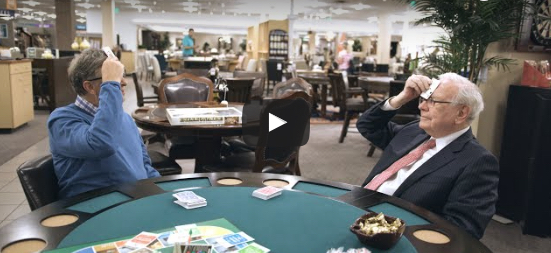
Warren Buffett takes Bill Gates on a tour of Nebraska Furniture Mart, a super-successful megastore owned by Berkshire. They tried out some lounge chairs, played with remote-controlled mattresses, and somehow managed to get lost. Enjoy...
Investing is often seen as complicated. And this has been made worse over the years by the increasing complexity in terms of investment products and choices, regulations and rules around investing, the role of the information revolution and social media in amplifying the noise around investment markets and the expanding ways available to access various investments.
But at its core, the basic principles of successful investing are simple. And one way to demonstrate that is in charts or pictures – after all, a picture tells a thousand words.
This note looks at five charts I find useful in understanding investing. Check back soon as another 5 charts are coming your way.
The past financial year turned out far better for investors than had been feared a year ago. This was despite a lengthy list of things to worry about: starting with the Brexit vote and a messy election outcome in Australia both just before the financial year started; concerns about global growth, profits and deflation a year ago; Donald Trump being elected President in the US with some predicting a debilitating global trade war as a result; various elections across Europe feared to see populists gain power; the US Federal Reserve resuming interest rate hikes; North Korea stepping up its missile tests; China moving to put the brakes on its economy amidst ever present concern about its debt levels; and messy growth in Australia along with perennial fears of a property crash and banking crisis.
Predictions of some sort of global financial crisis in 2016 were all the rage. But the last financial year provided a classic reminder to investors to turn down the noise on all the events swirling around investment markets and associated predictions of disaster, and how, when the crowd is negative, things can surprise for the better. But will returns remain reasonable? After reviewing the returns of the last financial year, this note looks at the investment outlook for the 2017-18 financial year.
Three reasons not to be fussed...
For much of this year, there has been a surprising divergence between share and bond markets with shares up in response to improving growth and bond yields down in response to weak inflation.
Some feared that either bonds or equities had it wrong, but in a way it seemed like Goldilocks all over again – not too hot (ie benign inflation) but not too cold (ie good growth). However, the past week or so has seen a sharp back up in bond yields – mainly in response to several central banks warning of an eventual tightening in monetary policy.
Over the last week or so, 10 year bond yields rose 0.2-0.3% in the US, UK, Germany and Australia. This may not seem a lot but when bond yields are this low it actually is – German bond yields nearly doubled. This caused a bit of a wobble in share markets.
The big question is: are we seeing a resumption of the rising trend in bond yields that got underway last year and what does this mean for yield sensitive investments and shares? Since central banks are critical in all of this we’ll start there.... Read on